The space economy is no longer a collection of isolated missions—it is becoming a complex, interconnected system of systems.
Commercial launch vehicles, satellite constellations, in-space services, lunar infrastructure, and downstream applications are coming online at an unprecedented pace. Yet, much like the early days of the internet, we risk building a fragmented space ecosystem if we don’t establish a common architectural framework.
That is why it may be time to ask: Do we need an OSI model for space?
The Case for an OSI Model for Space
The Open Systems Interconnection (OSI) model was created in the 1970s to solve a simple but critical problem: how to enable different systems, built by different organizations, to communicate seamlessly.
In space, we face a similar challenge. Hundreds or even thousands of satellites, spacecraft, ground stations, lunar assets, and data services—built by different companies and nations—must interoperate securely, reliably, and efficiently.
Without a shared architecture, we risk vendor lock-in, mission fragility, escalating costs, and slower innovation.
An OSI-inspired model for space could provide the common language and interfaces needed to unlock the full potential of the space economy.
“Architecture is not about constraining innovation. It is about ensuring that innovation can scale.”
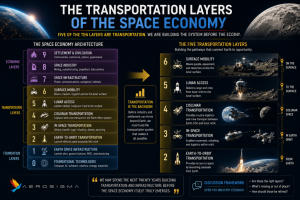
Layers of the Space Economy Architecture
A space OSI model could be structured into layers such as:
1 Infrastructure Layer: Spacecraft buses, launch vehicles, ground stations, and power systems
7 Application Layer: Services and applications delivered to users (communications, imaging, navigation, in-space manufacturing, etc.)
6 Data Layer: Data formats, semantics, and knowledge representation
5 Network Layer: Routing, timing, and network management (space and ground)
4 Transport Layer: Reliable data transfer, synchronization, and quality of service
3 Link Layer: Laser, RF, and other communication link protocols
2 Physical Layer: Hardware interfaces, modulation, coding, and signal characteristics