As the space industry grows increasingly complex, is it time for a common framework that helps explain how the various layers of the emerging space economy fit together?
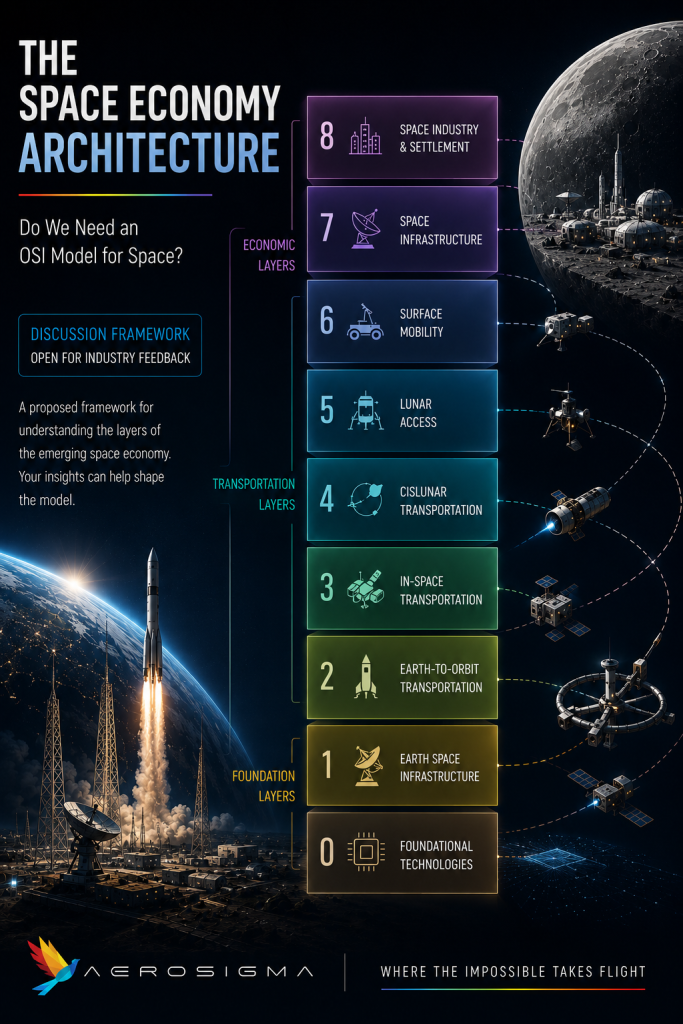
This article proposes an early draft of what I am calling the Space Economy Architecture (SEA), inspired by the layered reference models that helped organize and accelerate the growth of the computer industry. The objective is not to define a standard. It is to start a discussion.
Why a Space Economy Architecture?
One of the reasons the computer industry was able to scale so successfully was the development of common architectural frameworks that helped engineers understand increasingly complex systems.
The OSI (Open Systems Interconnection) model is perhaps the best-known example. Rather than treating networking as a single monolithic system, it organized the industry into layers. In a layered architecture, each layer provides capabilities to the layers above it while relying on capabilities provided by the layers below. This allows increasingly complex systems to emerge without requiring every participant to understand the entire stack. Engineers could focus on specific domains while still understanding how their work fit into the broader ecosystem.
The value of the OSI model was not that it perfectly described every network. Its value was that it created a common language for discussing complexity.
The space industry may be approaching a similar point. Discussions about the future of space often focus on individual technologies, companies, or missions. Launch providers, satellite constellations, lunar landers, orbital stations, resource extraction systems, power infrastructure, and future settlements are frequently discussed as separate topics. Yet all of these systems ultimately depend upon one another.
Layer
Primary Function
Representative Organizations
0
Foundational Technologies
NVIDIA, Microsoft, Google
1
Earth Space Infrastructure
NASA, SpaceX, ESA
2
Earth-to-Orbit Transportation
SpaceX, Blue Origin, ULA
3
In-Space Transportation
Impulse Space, Orbit Fab, Astroscale
4
Cislunar Transportation
NASA, SpaceX, Blue Origin
5
Lunar Access
Intuitive Machines, Firefly Aerospace, Blue Origin
6
Surface Mobility
Astrolab, Lunar Outpost, Toyota/JAXA
7
Space Infrastructure
Axiom Space, Redwire, Vast
8
Space Industry
AstroForge, Interlune, ispace
9
Settlement & Civilization
Not Yet Established
Before diving into the framework itself, there are a few initial questions that you may be able to help me better understand. I invite perspectives from professionals across the industry.
Some initial questions:
Are these the right layers?
Which layers are missing?
Should communications and navigation have their own layer?
Where do space stations fit?
Should transportation be divided differently?
Is a layered architecture even the right way to model the space economy?
Is a framework like this useful, or does it oversimplify the industry?
If the concept has merit, perhaps the model can evolve through collaboration and discussion.
A Draft Space Economy Architecture (SEA)
The framework below represents an initial attempt to organize the emerging space economy into layers. The definitions are intentionally broad and almost certainly incomplete.
For simplicity, the architecture can be grouped into three major categories:
Foundation Layers
Layer 0 – Foundational Technologies
Layer 1 – Earth Space Infrastructure
Transportation Layers
Layer 2 – Earth-to-Orbit Transportation
Layer 3 – In-Space Transportation
Layer 4 – Cislunar Transportation
Layer 5 – Lunar Access
Layer 6 – Surface Mobility
Economic Layers
Layer 7 – Space Infrastructure
Layer 8 – Space Industry
Layer 9 – Settlement & Civilization
The examples shown above are intended to be illustrative rather than exhaustive. Many organizations span multiple layers, and some layers remain far more mature than others.
Understanding the Layers
Foundation Layers
The foundation layers are largely invisible to most discussions about the future of space, yet every higher layer depends upon them. Much as modern aviation depends upon advances in computing, materials, communications, and manufacturing, the space economy is built upon technologies and infrastructure that often receive far less attention than the vehicles and missions they enable.
Layer 0 – Foundational Technologies
This layer includes the technologies that make the modern space industry possible:
Computing
Software
Artificial Intelligence
Telecommunications
Robotics
Advanced Manufacturing
Energy Systems
Representative organizations include NVIDIA, Microsoft, and Google. While these companies are not typically viewed as part of the space industry, many of the computing, cloud, AI, and software capabilities used throughout the space ecosystem ultimately depend upon technologies they helped pioneer.
Without these technologies there would be no launch vehicles, mission control centers, tracking systems, spacecraft, or lunar infrastructure. This layer exists largely outside the space industry itself, yet it underpins everything above it.
Layer 1 – Earth Space Infrastructure
The next layer consists of the terrestrial infrastructure required to access and operate in space:
Launch sites
Mission control centers
Ground stations
Tracking networks
Manufacturing facilities
Integration facilities
Test facilities
Representative organizations include NASA, SpaceX, and the European Space Agency (ESA). These organizations operate or support much of the infrastructure required for modern space operations, including launch facilities, tracking networks, mission operations, and testing facilities.
If Layer 0 provides the technological foundation, Layer 1 provides the operational foundation. Every launch, mission, and transportation system depends on this infrastructure.
Transportation Layers
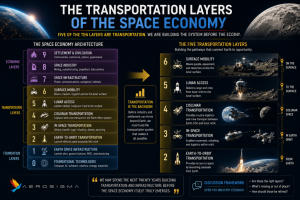
One of the most interesting observations that emerged while developing this framework is that transportation occupies five of the ten proposed layers.
That may simply reflect where the industry currently is in its development. Before large-scale industry, commerce, and settlement can emerge beyond Earth, the transportation systems that support them must first exist. In many ways, today’s space industry resembles the era when railroads, shipping lines, ports, and aviation networks were being established on Earth before the economies they would eventually support reached maturity.
Layer 2 – Earth-to-Orbit Transportation
This layer moves people and cargo from Earth’s surface into orbit.
Representative organizations include SpaceX, Blue Origin, and United Launch Alliance (ULA).
Examples include:
Falcon 9
Starship
New Glenn
Vulcan
Ariane 6
Long March
This is currently the most mature commercial transportation layer and arguably the layer that has attracted the largest amount of investment, engineering talent, and public attention. It provides access to space itself. Without it, every higher layer disappears.
Layer 3 – In-Space Transportation
Once cargo reaches orbit, it often needs to move elsewhere. Satellites require orbital insertion, spacecraft require servicing, and future space infrastructure may require the movement of equipment, propellant, and resources between destinations. This layer focuses on mobility within Earth orbit.
This layer may include:
Space tugs
Orbital transfer vehicles
Refueling systems
Propellant depots
Satellite servicing systems
Representative organizations include Impulse Space, Orbit Fab, and Astroscale.
In many ways, this layer resembles the trucking, rail, and freight networks that distribute goods after they arrive at a port or airport. While still in its early stages, in-space transportation may eventually become one of the most important enabling layers of the space economy.
Layer 4 – Cislunar Transportation
This layer extends transportation beyond Earth orbit into the Earth-Moon system and provides logistics between gravitational systems, Earth-Moon transportation network and future Mars transportation network.
Potential examples include:
Cargo transports
Crew transports
Logistics vehicles
Gateway support systems
Representative organizations currently include NASA, SpaceX, and Blue Origin.
If Layer 2 created access to orbit, Layer 4 begins creating transportation corridors between worlds. This layer remains relatively immature today, but it may become one of the most strategically important transportation systems developed during the next two decades.
Layer 5 – Lunar Access
Reaching lunar orbit is not the same as reaching the lunar surface. Cargo, equipment, and eventually people must still descend safely through the final stage of the journey.
This layer includes the systems responsible for transporting people and cargo between orbit and the Moon:
Blue Moon
Starship HLS
Blue Ghost
Nova-C
Griffin
Representative organizations include Intuitive Machines, Firefly Aerospace, and Blue Origin.
Just as ports connect ocean transportation to inland transportation on Earth, lunar landers connect cislunar transportation systems to surface operations.
Layer 6 – Surface Mobility
Transportation does not end upon arrival. Economic activity requires movement across the lunar surface.
Potential systems include:
Astrolab FLEX
Lunar Outpost vehicles
Toyota/JAXA concepts
Autonomous cargo haulers
Representative organizations include Astrolab, Lunar Outpost, and Toyota/JAXA.
Future mobility systems may transport people, cargo, resources, construction equipment, and infrastructure components across large distances on the Moon. The role they play may ultimately resemble the role of trucks, railroads, construction equipment, and utility vehicles during the development of terrestrial economies.
A lunar economy requires transportation to the Moon. It also requires transportation on the Moon.
Economic Layers
The upper layers represent the activities that transportation ultimately enables.
Transportation enables infrastructure. Infrastructure enables industry. Industry enables settlement.
While many discussions about the future of space focus on mining, manufacturing, and future cities on the Moon or Mars, the framework suggests that these activities may depend upon a substantial transportation and infrastructure foundation that must first be established.
Layer 7 – Space Infrastructure
Once transportation systems exist, infrastructure can begin to emerge. This layer may eventually include:
Power generation and distribution
Communications networks
Navigation systems
Habitats
Resource processing facilities
Data infrastructure
Representative organizations may include Axiom Space, Redwire, and Vast.
One question I continue to wrestle with is whether this should remain a single layer or eventually be divided into multiple infrastructure layers. Power, communications, navigation, and habitation could each evolve into major industries with architectures of their own.
Layer 8 – Space Industry
This layer represents productive economic activity.
Potential examples include:
Mining
Resource extraction
Propellant production
Manufacturing
Scientific facilities
Data centers
Representative organizations may include AstroForge, Interlune, and ispace.
Infrastructure enabled industrial development on Earth. It may play a similar role beyond Earth. However, this layer remains highly speculative because many of the business models, technologies, and markets are still emerging.
Layer 9 – Settlement & Civilization
The highest layer represents permanent communities and the broader social and economic systems that emerge around them.
Potential examples include:
Permanent workforce
Local governance
Communities
Universities
Research institutions
Tourism
Commerce
Civic infrastructure
Unlike the lower layers, there are currently no organizations that fit neatly within this category because the layer itself does not yet exist in a meaningful economic sense.
That observation may be one of the most important insights of the framework. Much of today’s space industry is focused on building the transportation and infrastructure layers required before large-scale settlement can emerge. At this level, transportation becomes increasingly invisible while the activities it enables become increasingly important.
At this level, transportation becomes increasingly invisible while the activities it enables become increasingly important.
About the Author
Vik Kachoria
Founder & CEO
Aerospace entrepreneur, investor, and strategist with more than four decades of experience across aerospace, finance, engineering, and venture development.