For most of human history, every known world fit within a single Solar System.
The stars filled the night sky, but whether they hosted planets of their own remained one of astronomy’s oldest unanswered questions. Philosophers speculated. Scientists theorized. Science fiction writers imagined civilizations orbiting distant suns. Yet for centuries, no one knew the answer.
Today we do.
The universe is not merely filled with stars.
It is filled with worlds.
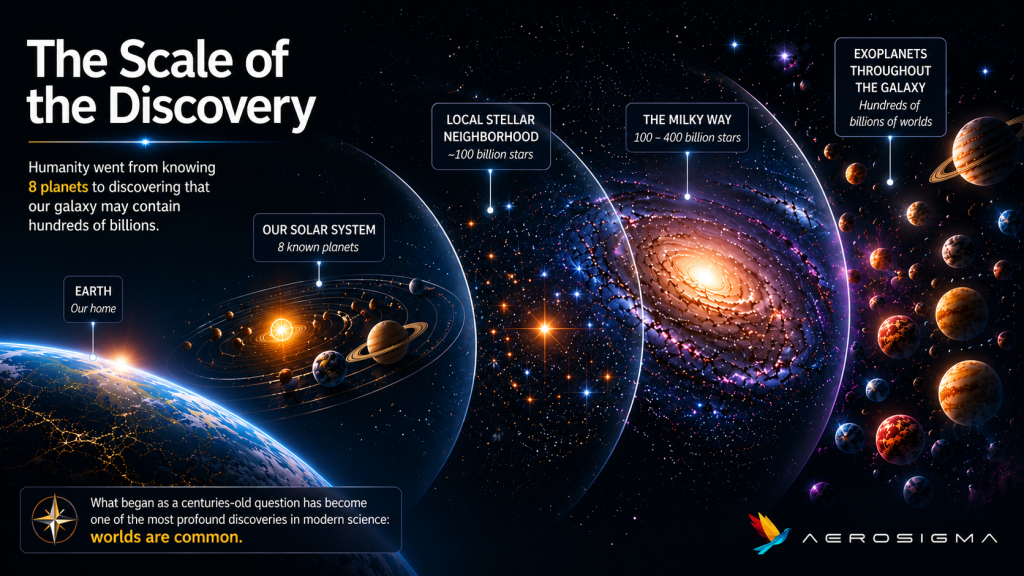
More than 5,000 exoplanets—planets orbiting stars beyond our Sun—have already been discovered. Thousands more await confirmation, and current estimates suggest there may be hundreds of billions of planets within the Milky Way alone. What began as one of humanity’s oldest questions has become one of the most significant scientific discoveries of the modern era.
Yet the most important implication is not just philosophical, it is beginning to shape the future of aerospace itself.
As scientists move beyond finding distant worlds and toward understanding them, entirely new generations of observatories, manufacturing systems, orbital infrastructure, and exploration technologies may be required. The search for planets is gradually becoming a challenge of capability rather than discovery, and the systems developed to meet that challenge may influence aerospace development for decades to come.
More than 5,000 exoplanets — planets orbiting stars beyond our Sun — have already been discovered.
The Great Planet Revelation
From Theory to Observation
The first confirmed exoplanet orbiting a Sun-like star was discovered in 1995. Prior to that moment, planetary systems beyond our own existed largely as theory. Scientists strongly suspected they were common, but there was no proof.
What followed was one of the most rapid scientific revolutions in modern astronomy.
Today, discoveries occur so routinely that individual exoplanets rarely make headlines unless they possess particularly unusual characteristics. Some are larger than Jupiter and orbit astonishingly close to their stars. Others are rocky worlds similar in size to Earth. Some orbit binary star systems, while others may wander through interstellar space without a parent star at all.
The greatest surprise was not that other planets exist. The surprise was that the universe appears extraordinarily good at making them.
A Galaxy Filled with Worlds
The Milky Way contains between 100 and 400 billion stars, and current evidence suggests that most of those stars host planetary systems. Many appear to host multiple planets. Our Solar System is not an exception; it may be one example among hundreds of billions.
For humanity, this represents a profound shift in perspective. Earth is no longer viewed as a lone planetary oasis surrounded by empty stars. Instead, we increasingly see the galaxy as a vast archipelago of worlds, each with its own history, chemistry, geology, and possibilities.
For the first time in history, humanity can look at the night sky and know that many of those stars are suns surrounded by planets of their own.
A Shift in Perspective
The discovery of exoplanets continues a pattern that has repeated throughout scientific history.
Earth is not the center of the Solar System. The Sun is not the center of the galaxy. The Milky Way is not the only galaxy. Now we know that our planetary system is not unique either.
But unlike earlier revolutions in perspective, this one does not merely shrink humanity’s place in the universe. It expands the map of possibility.
The Three Phases of Exoplanet Exploration
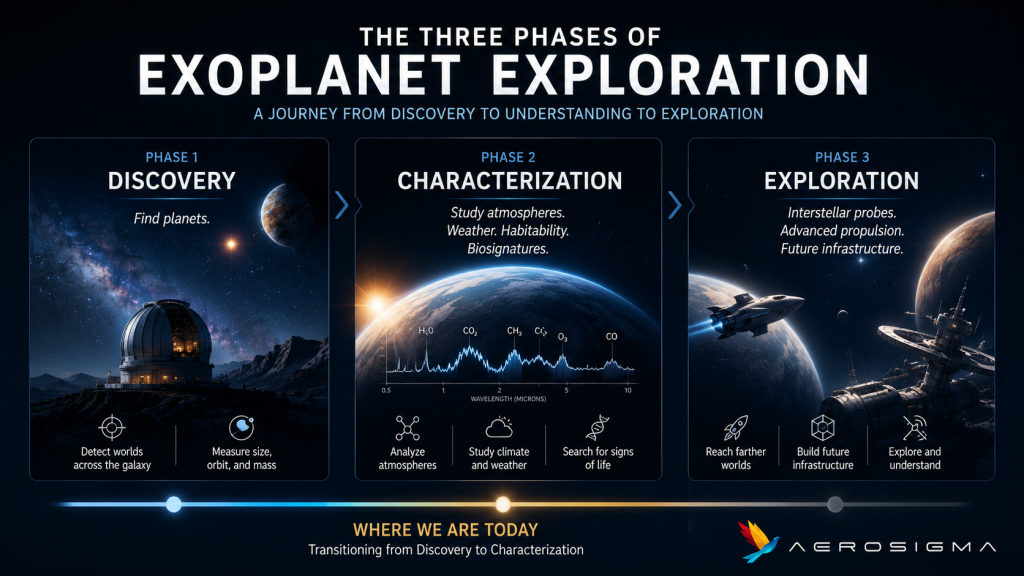
Exoplanet science can be viewed as progressing through three distinct phases.
The first phase was discovery. The objective was straightforward: determine whether planets exist around other stars. After three decades of observations, that question has largely been answered.
The second phase is characterization. Scientists now seek to understand what these worlds are actually like. What are their atmospheres made of? Do they possess oceans? Are their climates stable? Could some support life?
The third phase is exploration. This remains far beyond current capabilities, but it represents the long-term horizon. Direct investigation of nearby planetary systems would require advances in propulsion, energy generation, autonomous systems, and space infrastructure that do not yet exist.
Humanity has largely completed the first phase and is entering the second. The technologies required for that transition are becoming increasingly important to the broader aerospace ecosystem.
The first era of exoplanet science was about proving that other worlds exist. The next era is about learning whether any of them matter.
The Next Scientific Frontier
Beyond Detection
Finding a planet tells us that it exists. Understanding a planet tells us what kind of world it may be.
The next generation of astronomical research will focus increasingly on planetary environments rather than planetary inventories. Scientists are beginning to study atmospheric composition, surface temperatures, weather systems, water vapor, methane, oxygen, and other chemical signatures that reveal how these worlds function.
One of the most intriguing goals is the search for biosignatures—observable signs that biological activity may be present. No one knows whether such evidence will be found. Yet even the discovery of simple microbial life elsewhere would rank among the most important scientific breakthroughs in human history. It would fundamentally change our understanding of biology, evolution, and humanity’s place in the cosmos.
About the Author
Vik Kachoria
Founder & CEO
Aerospace entrepreneur, investor, and strategist with more than four decades of experience across aerospace, finance, engineering, and venture development.