The first article in this series argued that Artemis may eventually be remembered as a Wright Brothers moment for space. Not because it creates a lunar economy, but because it demonstrates that one may someday be possible.
History suggests that proving something can be done and building an industry around it are very different achievements. The Wright Brothers proved powered flight was possible in 1903, but commercial aviation emerged only after decades of improvements in reliability, manufacturing, infrastructure, operations, financing, regulation, and public confidence. The economic revolution came not from a single aircraft, but from the transportation system that followed.
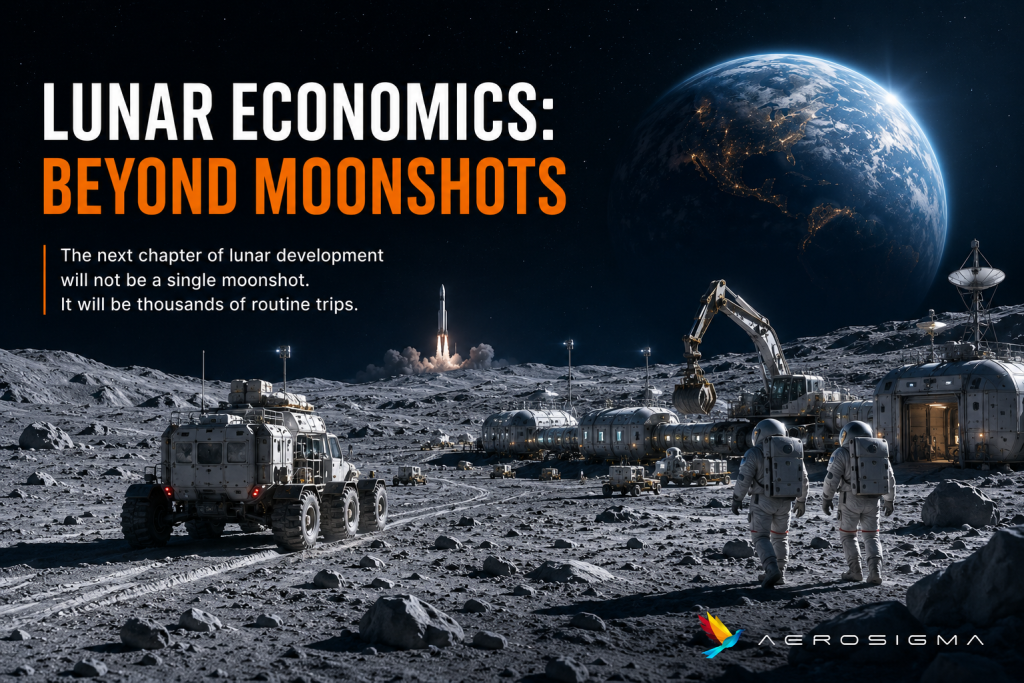
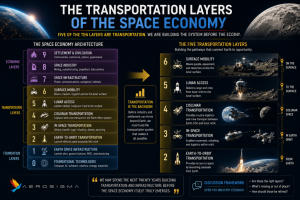
The Moon now faces a similar transition. Much of today’s discussion focuses on rockets, landers, habitats, mining equipment, and other visible technologies. Those technologies matter. Yet history suggests that transportation systems—not individual vehicles—are what ultimately transform demonstrations into economies. The central challenge is no longer reaching the Moon. The challenge is creating transportation that is frequent enough, reliable enough, and affordable enough that governments, companies, investors, and entrepreneurs can confidently build plans around it.
From Kitty Hawk to Commercial Aviation
History often remembers transportation revolutions through iconic machines: the Wright Flyer, the DC-3, the Boeing 707, and the Boeing 747. Yet none of these aircraft created commercial aviation by themselves.
What transformed aviation was the gradual emergence of an entire ecosystem. Airports were constructed. Navigation systems were deployed. Maintenance procedures became standardized. Manufacturing scaled. Pilot training matured. Insurance markets evolved. Financing mechanisms developed. Governments established regulatory frameworks that enabled airlines to operate safely and predictably.
Most importantly, reliability improved.
Passengers began purchasing tickets months in advance because they expected aircraft to depart and arrive on schedule. Businesses built global supply chains around air cargo because transportation became dependable enough to support normal planning. Investors committed capital because risks became measurable and infrastructure investments became economically rational.
Transportation systems become economically valuable when people stop treating them as extraordinary events and start treating them as dependable infrastructure.
Transportation systems become economically valuable when people begin planning around them.
That lesson may ultimately prove more important for the Moon than any individual spacecraft.
Why Cadence Matters More Than Capability
Much of the public discussion surrounding lunar development focuses on technical capability.
Can we build larger rockets? Can we establish lunar bases? Can we mine lunar resources? Can we manufacture products on the Moon?
These are important questions. However, transportation history suggests they may not be the first questions that need to be answered.
A transportation system that operates once every few years supports exploration. A transportation system that operates every day supports an economy.
The significance of Starship is not simply its size or payload capability. Its larger significance is that it represents one of the first serious attempts to treat space transportation as an operational system rather than a collection of bespoke missions. SpaceX has publicly discussed long-term ambitions that could eventually involve hundreds or even thousands of launches per year. Whether those exact numbers are achieved remains uncertain. What matters is the underlying shift in thinking.
Traditional space programs have largely optimized for mission success. Future transportation systems may optimize for operational tempo. Aviation provides a useful comparison. The value of commercial aviation is not that aircraft can cross oceans. The value comes from the fact that thousands of aircraft do so every day with predictable schedules, established maintenance systems, known operating costs, and manageable levels of risk.
The same transition remains ahead for lunar transportation.
The Transportation Flywheel
Transportation systems rarely scale through simple linear growth. Instead, they often grow through self-reinforcing cycles that improve economics, reliability, and infrastructure simultaneously.
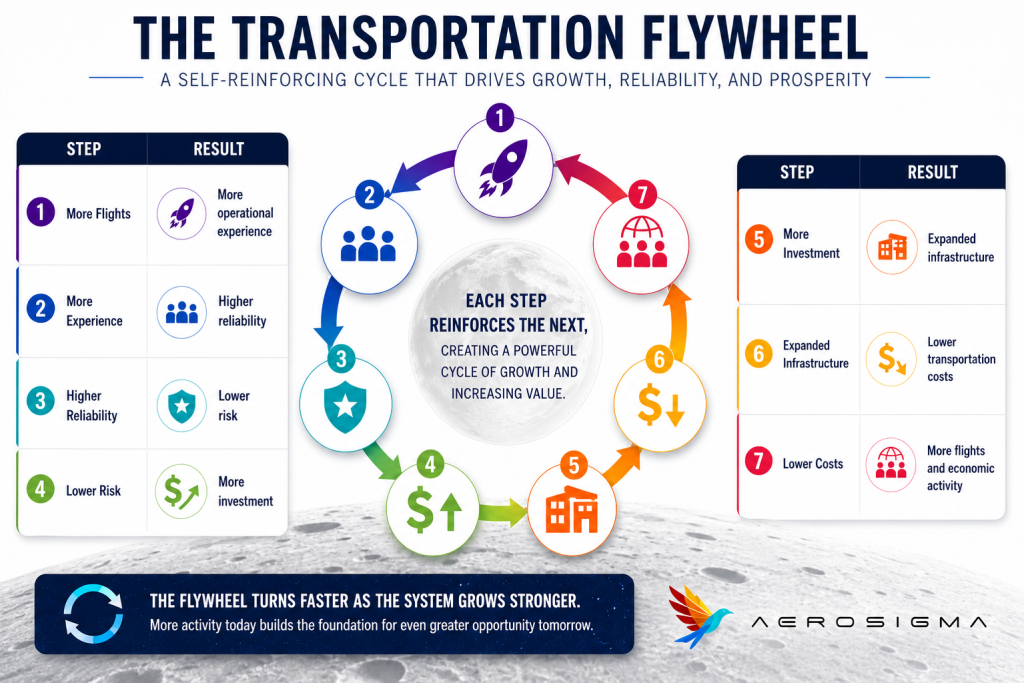
As transportation becomes more frequent, operators gain experience. Greater experience improves reliability. Improved reliability reduces risk. Lower risk attracts capital. Capital funds infrastructure. Infrastructure reduces costs. Lower costs enable even more transportation activity. The cycle then repeats.
The Transportation Flywheel
This pattern can be observed repeatedly throughout transportation history. Railroads, commercial aviation, container shipping, and telecommunications networks all experienced similar feedback loops as infrastructure, operations, and economics reinforced one another.
A lunar economy is unlikely to emerge because a single transportation system becomes dramatically better than its predecessor. It is more likely to emerge because thousands of missions gradually improve the economics, reliability, and operational maturity of the entire transportation ecosystem.
Transportation Creates Economies
Every proposed lunar industry depends on moving equipment, supplies, replacement parts, fuel, construction materials, robotics systems, and eventually people between Earth, lunar orbit, and the lunar surface. Transportation costs influence every economic activity that follows.
Historically, transportation systems have evolved in remarkably similar ways.
System
Early Purpose
Mature Economic Role
Railroads
Exploration and territorial expansion
National commerce and industry
Aviation
Demonstration and experimentation
Global transportation infrastructure
Container Shipping
Cargo movement
Foundation of global trade
Lunar Transportation
Exploration and science
Future economic infrastructure
The challenge facing the Moon today is that transportation remains measured in missions rather than operations. Artemis missions occur years apart. Lunar cargo transportation effectively does not exist at meaningful scale. Every mission remains a major undertaking requiring extensive planning, specialized infrastructure, and substantial government involvement.
Commercial aviation provides a useful contrast. More than 100,000 flights operate worldwide every day. Most travelers rarely think about the extraordinary engineering involved because transportation has become routine. The economic challenge facing the Moon is not simply reaching it. The challenge is closing the gap between those two operating models.
SpaceX’s long-term vision for Starship illustrates the scale of change required. Public discussions have included aspirations for hundreds or even thousands of launches annually. Whether those exact numbers are achieved is less important than the broader point: transportation systems become economically transformative only when operations become frequent enough to drive down costs and improve reliability.
Cargo will likely drive this transition long before passenger transportation does. Potential freight categories may include:
Construction materials
Mining and excavation equipment
Propellant production systems
Power generation infrastructure
Scientific instruments
Communications equipment
Industrial machinery
Replacement parts and consumables
About the Author
Vik Kachoria
Founder & CEO
Aerospace entrepreneur, investor, and strategist with more than four decades of experience across aerospace, finance, engineering, and venture development.